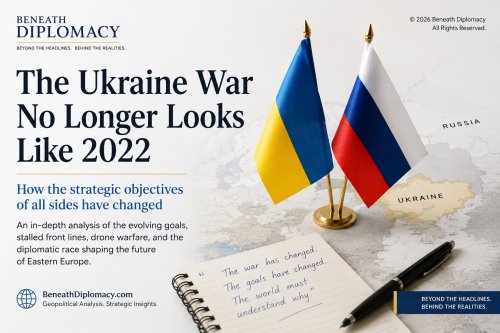
The Ukraine War No Longer Looks Like 2022
The Ukraine war has entered a new phase where territorial expansion has given way to attrition, drone warfare, and diplomatic negotiations. This analysis examines how Russia's and Ukraine's strategic objectives have evolved since 2022, the impact of stalled front lines, peace talks, NATO, Donbas, Crimea, and what the changing nature of the conflict means for Europe and global security.

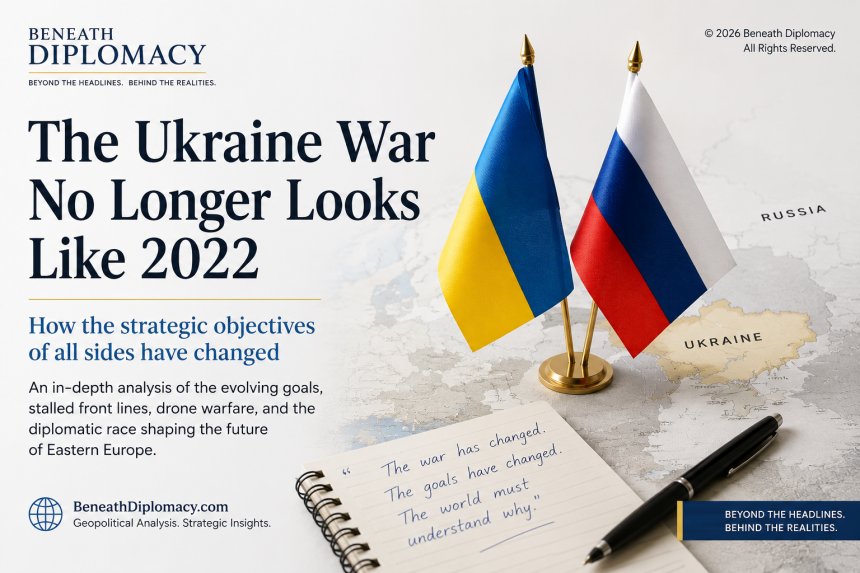
How the strategic objectives of all sides have changed
Four and a half years into this war, something strange has happened. The shelling hasn't stopped. The drones haven't gone home. It is hard not notice, the skies over Kyiv and Moscow are busier than they've ever been. But if you actually sit down and ask what each side is fighting for right now, you get a very different answer than you would have gotten in February 2022.
Back then, Russia's goals were enormous. Topple the government in Kyiv, install something friendlier, keep Ukraine out of NATO forever, make sure the country never posed a threat again. Ukraine's goal was simpler and more desperate. It was to survive. Don't get overrun in week one. Four years of grinding, expensive, occasionally shocking warfare later, both of those goals have been sanded down into something narrower and, frankly, more negotiable.
The front line basically stopped moving
Start with the fighting, because everything else follows from it. People who track this closely describe 2026 as a strange combination of stalemate and chaos. Russia still has more soldiers to throw at the problem, and it keeps probing along a front that stretches something like 1,200 kilometers. But the big sweeping advances from 2024 and early 2025 have slowed to almost nothing. Russia's territorial gains over the last month were measured in a few dozen square miles. That's smaller than a mid sized American county. Compare that to the early days of the invasion, when whole regions changed hands in weeks.
A lot of this comes down to drones. Cheap, disposable, everywhere. First person view strike drones and constant aerial surveillance have made it almost impossible for either army to gather troops or armor without getting spotted and hit within minutes. The old approach of massing tanks and punching a hole in the line just doesn't work the way it used to when every field is being watched. So the war has turned into something slower and uglier: attrition, logistics, and strikes on things far behind the actual front, refineries, power plants, rail lines, rather than a race for territory.
Ukraine has gone all in on this approach. Its long-range drones have been reaching deep into Russia, hitting oil facilities, weapons plants, even airspace close to Moscow, which forces Russia to pull air defenses away from the front to protect its own cities. Russia has responded with its own escalation, pounding Ukrainian cities and the power grid with missiles and drones through yet another brutal winter, leaving millions without heat or electricity for stretches at a time.
The talks have moved faster than the map has
Here's what's odd. While the actual battle lines barely twitch, the diplomacy has been almost frantic. Since the start of 2026, Washington has been pushing hard for a deal, with envoys Steve Witkoff and Jared Kushner bouncing between Kyiv, Moscow, Abu Dhabi and Geneva. At different points, both sides said they were close, really close. Ninety percent agreed, according to Zelenskyy at one stage, with security guarantees for Ukraine mostly settled and Kyiv even willing to drop its NATO bid in exchange for long term Western backing.
But that last ten percent won't budge, and it's almost entirely about land. Moscow wants Ukrainian troops out of the roughly one fifth of Donetsk province they still control, territory Russia has never managed to actually capture despite years of trying. Kyiv won't do it, and says any withdrawal would need to go to a national referendum, one that everyone involved knows would fail. Trump has floated some kind of free economic zone across the disputed Donbas as a compromise, but nothing has actually stuck.
Deadlines keep slipping past. There was supposed to be a deal by June 2026. There wasn't. Talks in Geneva that opened with real optimism collapsed after two hours on the second day, with both sides accusing the other of stalling. Russia has also started leaning on a new argument, that Zelenskyy's presidential term technically expired and he's no longer a legitimate signatory, since Ukraine hasn't held elections under martial law. Kyiv rejects that outright, but it's a telling move. It suggests the next fight might not just be about where the border sits, but about who even has the authority to draw it.
The goals just aren't what they were
This is really the part worth sitting with. Russia isn't fighting to erase Ukraine as a country anymore, whatever the opening weeks of the invasion suggested. That goal is gone. What's left is a much smaller ambition: lock in the territory it already holds, especially Donbas and Crimea, get some kind of international recognition for it, and squeeze concessions like a smaller Ukrainian military and no NATO membership.
Ukraine has changed too, just less dramatically. It's no longer fighting under the assumption that it can take back every inch of what it lost since 2014. That idea has quietly faded. What Ukraine is fighting for now is the right to exist as an independent state with guarantees that actually mean something, while using its own long range strikes and economic pressure on Russia to avoid walking into a deal from a position of weakness.
Even ordinary people seem worn down by it. Recent polling suggests a majority in both countries now want some kind of negotiated end to this, which is a real shift from the all or nothing mood of 2022 and 2023.
None of this means peace is around the corner. Donbas has outlasted more deadlines than anyone predicted, chewed through several rounds of shuttle diplomacy, and shows no sign of resolving itself soon. But the war people are reading about now, one of stalled trench lines, refinery fires, and arguments over free economic zones, doesn't look much like the war that started with tank columns racing toward Kyiv. The fighting hasn't stopped. The reasons behind it have just gotten smaller, and a lot more up for negotiation, than anyone expected back in 2022.
- International Relations
- Europe
- Russia & Ukraine
- Security & Defense
- Diplomacy
- Military Affairs
- Strategic Analysis